

How do you put into words an experience that has had such a profound impact on your life?
This is what I pondered when asked to contribute a piece of writing for a newsletter about my experience of Dialectical Behaviour Therapy (DBT). I wasn’t sure where to start. DBT was the best thing I’ve ever done; It saved my life. It also has given me a precious gift; a gift that no amount of money can buy: A life worth living. I wanted to create something special – something to show my gratitude for being given the opportunity to participate in the DBT program. I also wanted to create something that would show the whole DBT team at Metro North that all our hard work (theirs and mine) was worth it.
The time I spent in the DBT program wasn’t easy AND it was absolutely worth the hard work. DBT changed my life in so many ways and trying to explain my DBT journey with words alone felt impossible. It isn’t as simple as saying there was a “before DBT” and an “after DBT”. Graduating didn’t suddenly mean everything was easy or that I had nothing left to learn.
I decided to create four images to depict my journey: what life felt like before DBT, what going through DBT felt like, what I imagined life would be like after graduating, and what I have since discovered a life worth living actually looks like.
The thing is: there was one problem, and it was quite a big problem: I have always been terrible at art! It’s funny, as I wrote the last sentence I was reminded of the bell that we used in our DBT group sessions. In these sessions we were encouraged not to be judgemental towards ourselves or others. Often in group, when one of us said something that was judgemental, someone would ring the bell. The fact that I realised I was being judgemental towards myself just goes to show that learning doesn’t stop when you graduate DBT. In true DBT style I will rephrase my earlier sentence to simply say; ‘art is not one of my strongest suit’.
I often have pictures in my imagination that I would love to draw, but unfortunately being able to see something in your head doesn’t magically give you the ability to put it onto paper. Writing has always been much more my thing. This is one of the reasons I love Al these days. I can use something l am good at— describing an idea in words—to help create images that previously existed only in my head. I made these pictures with the help of ChatGPT, or “Chatty”, as I usually call him, a name borrowed from my nephews. Somehow, Chatty became a “he” for no particularly deep or meaningful reason, other than the fact that the name sounds more masculine to me.
Creating these images involved much more than typing “draw me a burning building” and waiting for the result. Chatty and I spent many hours over several days talking through my experiences and creating draft after draft. I wanted the pictures to represent what DBT felt like for me, sometimes down to the tiniest detail. It is probably fortunate that Chatty isn’t human, because a human would have lost patience with me long before I was happy with the images.
The woman in the pictures doesn’t physically look like me, and that was intentional! I wanted her to be anonymous enough that somebody else might look at her and see something of themselves. At the same time, when I look at her, she feels like me. She doesn’t feel like me because I’m tall and skinny with long hair but because I know what it is like to be the woman on the floor of the burning basement. I know what it is like to climb the ladder when every rung hurts. I recognise the woman imagining an impossibly perfect future, and I recognise the woman on the bike, continuing her journey with the things she loves travelling alongside her.
These pictures don’t necessarily represent everybody’s experience of DBT. They represent mine. They draw partly on metaphors from Marsha Linehan, who developed DBT (Linehan, 2015), and partly on what those ideas came to mean to me during DBT and in the year since graduating.

Before DBT: the burning basement
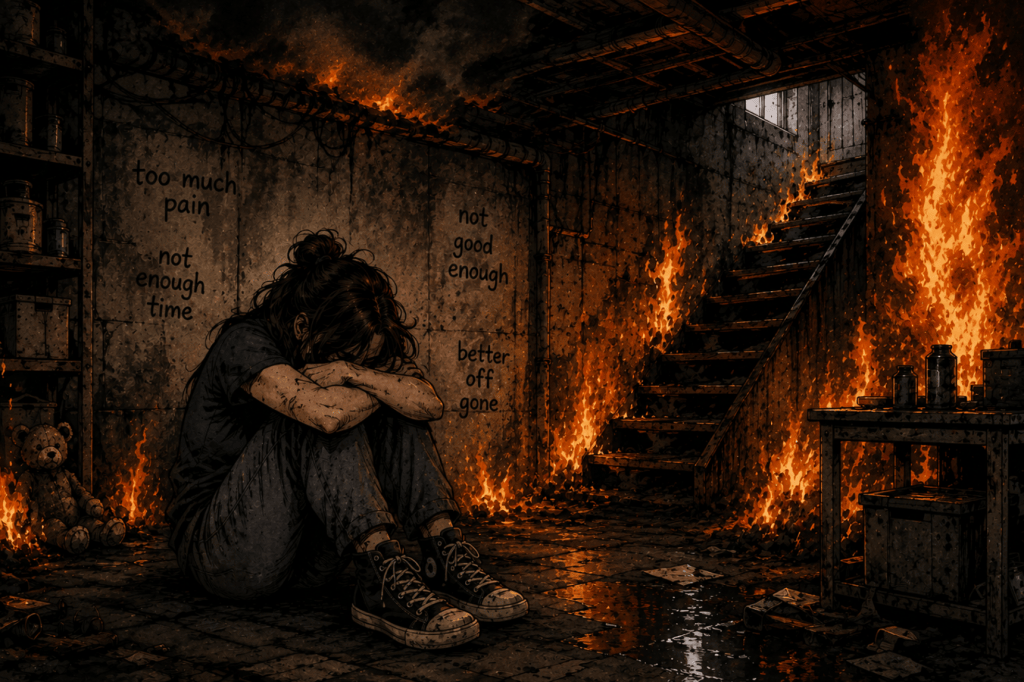
One of Marsha Linehan’s metaphors for severe emotional suffering is being trapped in a burning basement with only one way out: a ladder. The problem is that the basement is hot, and the ladder is hot too. Climbing towards something better is painful, so it is understandable that someone might let go and fall back down, even though that leaves them in the place they are desperately trying to escape.
Before DBT, life for me often felt as though I was trapped in that burning basement. When the emotional pain became intense, it was incredibly difficult to think about anything except finding a way to make it stop. For a long time, my way of doing that was to deliberately cause myself physical pain. It distracted me from what I was feeling and, if I hurt myself badly enough, it got me into hospital. Hospital might not sound appealing to most people, but back then it felt safer than being left alone with my emotions. It meant somebody else would look after me for a while.
Early into DBT, my therapist put a hypothesis to me that I was using hospital as a Band-Aid.
I told her, “I understand what you mean, but I need that Band-Aid, If I rip it off, there will be too much blood. How am I supposed to cope with all that blood?”
She replied, “We teach you the skills to cope with the blood.”
We both understood the analogy – neither us needed to explain that blood really meant my emotional pain. At the time, the idea that skills could ever be enough to help me manage that pain sounded too good to be true. Looking back, my therapist was right—as she usually was, if I’m being honest!
During this time my mind was rarely quiet. I spent an enormous amount of time worrying about relationships and what other people thought of me. Is this person angry with me? Have I done something wrong? Do they still like me? Why haven’t they replied to my message? I was constantly looking outside myself for reassurance. Looking back now, I think I needed everyone else to like me because I didn’t really like myself. It’s hard to like yourself when you are constantly in crisis.
The ways I coped with the emotional could give me some short term relief, but this relief never lasted. Eventually, I would find myself back in the same place, usually with even more problems than I had started with. My behaviours were destructive and at that time, felt like all l had.
If I had stayed in that burning basement, I would have died, probably sooner rather than later. The good news is that there was a way out of the burning basement – a ladder. I just didn’t know how to climb it yet.

Next post I will explore my life during DBT: climbing the hot metal ladder.
Thank you for reading.
Love, Luna.


Leave a Reply